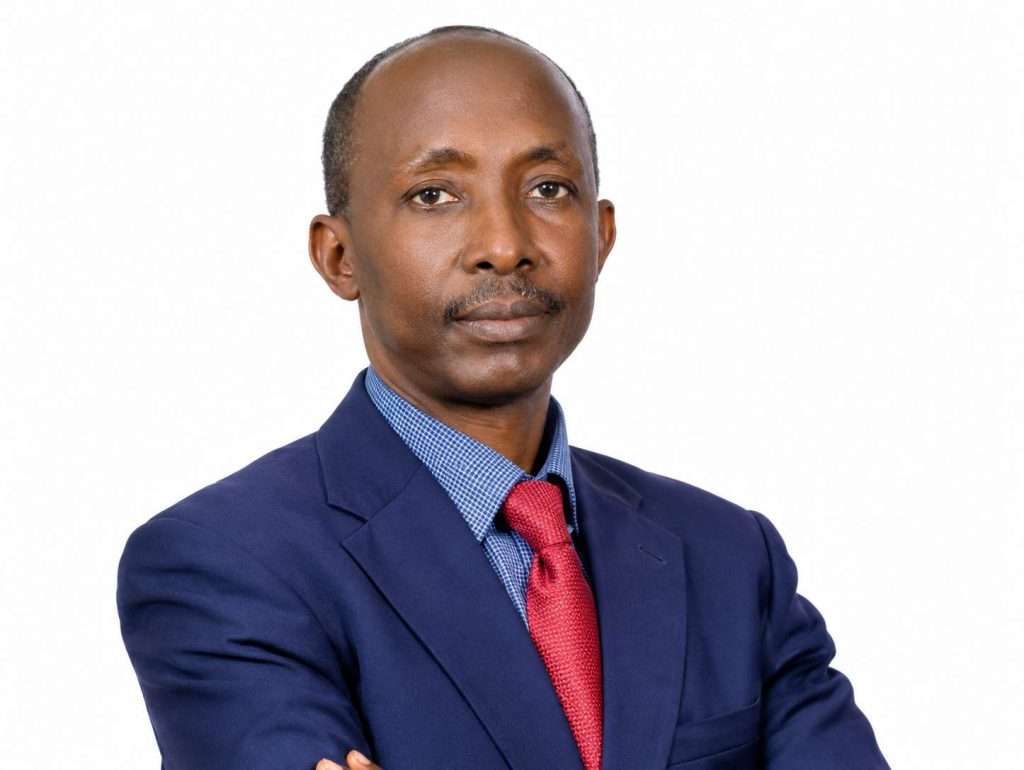
For over two decades, Simon Munyaneza, has built his career on innovation. Now, as Head of IT at Sonarwa General Insurance, he explains why his preference is almost always to build custom solutions from scratch rather than buy off the shelf.
When Simon Munyaneza arrived at the then Rwanda National Examinations Council in 2004, the director-general took him to a new four-storey building and left him in it.
“He said, Simon, this is the building. It is empty and I don't know what to do. So, it is you in charge,” he recalls.
There were no networks or software and nothing was connected to a power supply. Simon then set out to work, starting with the electricity and moving upwards and within a year, the building was fully connected and was even inaugurated by the president.
“Before then, people would travel long distances to get their results in hard copy from schools and after getting results, they would travel again to check if they had been placed to secondary school sections. I made sure that after achieving my MSc in network and e-business centred computing through Erasmus Mundus Scholarship by 2009, we could publish results online and disseminate them through USSD saving students time and money.”
The new system not only got recognition from the president but also earned the institution a UN public service award.
In 2010, Simon was back again building something new from the ground up. This time, the government of Rwanda had launched a nationwide land registration project and the Rwanda Natural Resources Authority came calling. There he designed and implemented the land tenure regularisation support system with only a team of four developers.
“I joined as a consultant IT specialist on the program. It was supposed to be a five-year program but we did it in three years. We were running 24/7 across five sites in the country and it was quite successful with every parcel of land in Rwanda captured in the system.”
He would then work as an advisor to the supreme court of Rwanda where he supported the building of the electronic case management system.
To buy or build
Throughout his many years finding solutions both in public and private sectors, Simon has often preferred to build from scratch as opposed to buying or layering on existing tech. Citing from his work at the Rwanda National Examinations Council and the land registration project, it is clear that the decision to build was not random.
In the case of Rwanda Examinations council, there was little time and nowhere to buy the kind of solution he envisioned.
“The concept we had, we didn't know where anywhere else was working, and so we felt, okay, let's start building. So, we started and it was like an agile way where we started small. For the land registration project, we needed expertise from different areas; developers and GIS specialists and others and we didn’t know where to find a solution that brought all these together, so we started building from scratch.”
The two projects also gave him lessons that he has carried with him even as he builds solutions for Sonarwa.
“Already-built software is sometimes hard to implement successfully. If you are able to build, you are likely to succeed with the project and in the time that you want, because you have the flexibility of getting the different resources you want.”
A product bought off the shelf, in his experience, is difficult to alter when requirements shift.
The physicist who never was
Simon owes his career in IT to his determination and a passion for technology that overcame obstacles in his way. In his younger days, his desire had been to pursue civil engineering. After secondary school, however, he was offered physics at Makerere University and, as an alternative, a higher diploma in electrical engineering at Kyambogo University.
“My big brother insisted that I should pursue a degree in physics because he felt it could not compare with a higher diploma. So it's like I was forced to go there but my mind was set on technology. That's all I ever planned to do.”
Fortunately for him, shortly after his graduation in 1996, a delegation from India came to interview graduates and through them, he got an opportunity to pursue an MCA in computer applications from the University of Madras. He then flew back home and took up his first job at the Commercial Bank of Rwanda in 2002.
More than two decades later, Simon leads the technology department at Sonarwa General Insurance. He initially joined in 2018 as the shared head of IT across both Sonarwa Life Assurance and Sonarwa General Insurance, later remaining with the General Insurance business when the two entities split. In his current role, he has continued building solutions mostly from scratch.
A legacy of innovating
One notable one is when Sonarwa Life was at risk of losing close to 4 billion RWF in revenue over a period of 3 years. The company needed a solution that could support payment of claims through an integration with a mobile money system as well as provide a USSD facility to view pension balances. Under Simon’s leadership, the solution was developed in six months and the business was secured.
Likewise, when he joined, the company was taking cash at its branch counters, and some of it was going missing. When the pandemic came and offices closed down, Simon had to build a system that could ensure business continuity.
His solution was to build a money payment system that not only enabled remote transactions but also allowed the finance office to see every mobile payment as it arrived. He then had to deal with the electronic billing machines that Rwanda uses to record tax.
“They used to have these small devices on every branch for tax collection, and you would find that the institution didn’t have a proper view of the records. I had to ensure that we have a centralised system for the electronic billing machines and that we could monitor transactions.”
Facing the headwinds
Simon considers cybersecurity a big challenge in the IT industry especially because he feels that solutions are expensive.
A second challenge, he has observed, is that investments rarely match the innovations needed.
“In private institutions, cost is a big issue. You have to convince them that with this investment this is how far we are going to go.”
He also notes that knowledge and infrastructure are expensive to invest in. For example, he believes that there are few people who have been trained in the proper and effective use of AI.
Even so, at Sonarwa, the company is working on integrating AI into operations though it’s still at a young stage.
When work stops
When he is not juggling work problems and trying to find solutions, Simon loves spending time with his family.
“I have five wonderful children and they make my day. When I get disturbed here, I go home and they give me comfort.”
Simon also carves out time for community and is actively involved in his church. He is also a hobby runner, doing five kilometres, at least three times a week, and has taken part in an amateur run for peace in Kigali.