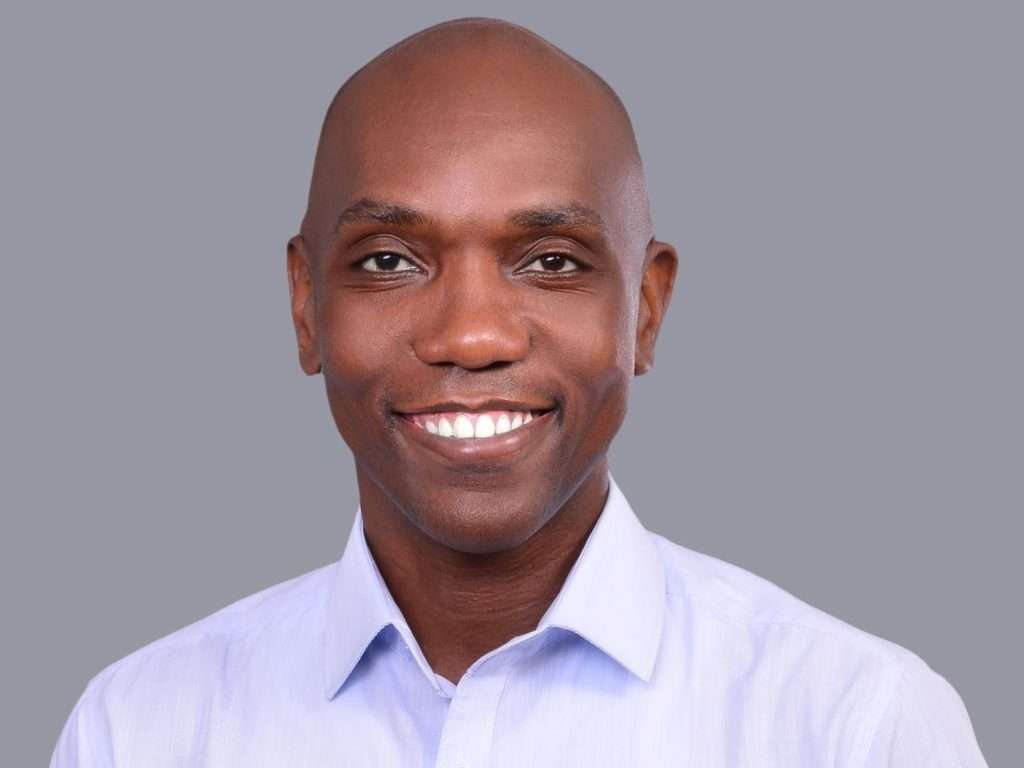
Russell Akuom’s love for computers was purely accidental, sparked by a stint in a cybercafé after high school. That chance encounter set him on a path that now sees him leading Nation Media Group’s digital strategy, while finding time for his hobbies like marathons, hikes and kickboxing.
Russell Akuom, the man now leading Nation Media Group’s digital strategy, once had no interest in computers. “In high school, I wasn’t really interested in computers,” he recalls. “During break times and lunch hours, I would see my classmates running to go to the computer labs, but I never bothered to go with them.”
Yet only a few years later, he found himself helping a neighbour at a cybercafé. And this is where he began to develop a fascination for networking and the internet.
That turning point came during a two-year gap after high school, when he and many of his peers were waiting to join university. “I would sometimes go with him just to help manage the cybercafé and I was intrigued by how the whole networking system worked and how people could log into the phenomenon that was the internet,” he says.
Those early days of setting up Hotmail and Yahoo email accounts and troubleshooting hardware, software and networking elements lit the spark that steered him towards a career in technology.
When it came to choosing a course at university, practicality won over passion. “I wanted to study something that I was already familiar with so that it would make my college experience easier,” he says. The institution he joined offered computer science, however the programme was not popular at the time, so he opted for electrical and electronics engineering, with a major in telecommunications engineering, which had elements of computing.
After university, he entered the telecommunications field as a telco and network engineer, starting at Kenya Data Networks, then Telkom Kenya, followed by Ericsson Kenya before moving to Safaricom. It did not take long for him to realise that what really excited him was how technology transforms lives. “I was always drawn towards solving problems for the customer,” he says.
Safaricom gave him the chance to explore that passion. He moved into its strategy and innovation unit, where cross-functional teams came together to brainstorm ideas, design products and bring them to market. One of his most dynamic assignments was with the M-Pesa team, where he worked on building new customer experiences.
Ideas alone not enough
“I realised I really liked coding because we were building products for customers,” he recalls. Teaching himself to code through YouTube tutorials, he applied those skills directly to live projects.
His next stop was the banking sector, where he saw an opportunity to apply his product development skills in a new environment. Working with Mpesa revealed to him the opportunities around the financial space that technology could exploit. At first, the move was exciting; banks had a wealth of customer data and the potential to build innovative services around it. But he quickly discovered that ideas alone were not enough. “If you had a maverick executive who wasn’t scared to experiment, you could knock yourself out,” he says. “But if you had one that was rather conservative, then it was a problem.”
The reality, he found, was that the industry leant heavily towards the conservative side. Meetings would end with great concepts on the table, only for them to stall in approval cycles or be shelved entirely. “We had lots of ideas but we couldn’t really bring them to fruition because of the conservative nature of the banking industry,” he recalls.
For someone who thrived on building and experimenting, it was a frustratingly slow pace that made him start thinking seriously about moving into leadership so he could open the door for bolder innovation.
That desire to be in a position where innovation could flow freely took him to Botswana, where he joined microfinance company Letshego to head the payments team. The role came with something he had been craving – executives who were ready to support bold ideas. “Here I interacted with very good executives who were really ready to support your ideas,” he says.
One of the most intriguing projects was experimenting with how young people could borrow using their digital assets, such as NFTs, as collateral. “No one actually really does that in the finance industry, but we built some prototypes,” he recalls, noting that they tested the concept in Nigeria and Rwanda despite its unconventional nature.
The work was stimulating, but the role eventually required him to relocate to Botswana full-time, something he could not do with a young family. Stepping away, he spent time on personal projects, including developing a remote smart vehicle monitoring system for NTSA and an AI-powered investment tool that could analyse annual reports and return company fundamentals on demand.
A new challenge
It was during this period that a long-discussed opportunity at Nation Media Group finally opened up. He had often debated with friends about what NMG could do differently, especially in the fast-moving digital space. “They told me, you’ve been talking a lot, now you have the opportunity to go and do it,” he says. That challenge, combined with his lifelong connection to the Daily Nation newspaper – as a young boy, his father would always insist on the Daily Nation whenever he sent him to buy newspapers – drew him to the CIO role, where he now aims to position the organisation as the home of “dynamic, interactive and immersive yet validated content” in an era flooded with misinformation and disinformation.
At NMG, his leadership style is rooted in empowerment. He manages a team of 52 and prefers to have them think through challenges and propose their own solutions.
“When it comes from them, I see how religiously they solve it as opposed to when it came from me,” he says. The approach was inspired by one of his former managers, who, when presented with a problem, would simply ask: What would you do about it? It taught him that ownership fuels commitment.
Outside the office, he reads widely but gravitates towards African fiction and history. Chimamanda Ngozi Adichie is his favourite author, with her novels offering an escape into a different world, while historian Yuval Noah Harari has shaped his understanding of the past and its tendency to repeat itself. “We never really learn from history,” he reflects, a thought that underpins his belief in being proactive about the future.
His free time is equally active. He has run marathons across Africa, hiked several trails and mountains with Rwenzori being his highlight, which he says is far more challenging than Kilimanjaro. He also keeps fit through kickboxing, a sport he almost pursued professionally before his wife advised otherwise.
In his parting shot, he recalls a familiar adage: “Time is the most important resource,” he says. “Once it’s gone, you can’t get it back, so I want to spend mine building things that matter.”