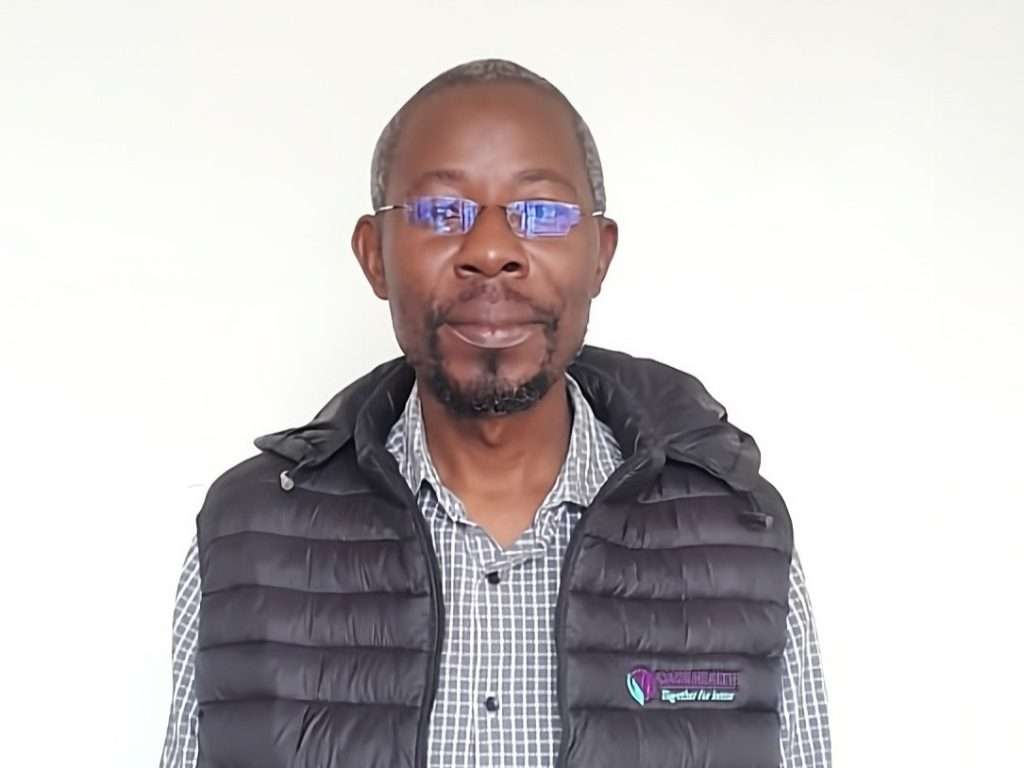
Long before he was leading IT at Oasis Healthcare, John Paul Oduor was harvesting flowers as a casual labourer, armed with a diploma in IT and a quiet determination to do more. His story is about saying yes, again and again, and building from wherever you stand.
John Paul Oduor, now head of IT at Oasis Healthcare Group, once found himself in gumboots instead of a server room. Then, his days were spent as a manual labourer on a flower farm, harvesting stems for hours on end, doing physically demanding work that had nothing to do with the diploma in IT he had studied for.
On paper, he had already invested in his future. In reality, he was toiling in the fields, waiting for an opportunity to knock on his door.
At the time, he still thought he might end up somewhere completely different.
“Basically, I wanted to do lab tech,” he says. “Graphic design was also part of the picture. I’ve always enjoyed it. It just came naturally to me.”
Leading IT across a healthcare network was not even on the radar. Then came the question that would quietly change everything.
“One day someone at the farm approached the workers and asked, can anybody here type using a computer?” he remembers. While others kept quiet, John Paul spoke up. “I said, here I am, I can.”
And with that simple response, he was moved from the field into an office, where he was asked to help enter data into spreadsheets for a few weeks.
It may have seemed like a small task at the time, but for him it was something more.
“He just gave me instructions on how to deal with it, and I managed,” he says.
The office door opens
What started as two weeks of assisting with data entry became the first real glimpse of a different future.
For the first time, he was working with data. He was inside the office. And in his heart, he felt that he belonged there.
But opportunity, as he would soon learn, does not arrive without tension. The shift from the farm to the office did not sit well with everyone.
“One of the supervisors called me and angrily asked what I was doing there,” he recalls. “There were murmurs among my colleagues about why I was no longer in the field. Many of them thought that being in the office meant I wasn’t doing any real work.”
“The supervisor stated that he could terminate my employment. I responded that there was no need for that and indicated that I would resign instead. He then proceeded to issue me with a paper to prove that I can,” he recounts.
“In that moment I told him, ‘I’m even more learned than you,’” he recalls. “It was bold, maybe too bold. Things escalated quickly. I even drafted my resignation letter and took it to HR because I was ready to leave. But HR counselled me, addressed the issue internally, and asked me to stay.”
The incident, dramatic as it was, did not end his office stint. It cemented it.
“That story went round,” he says, almost surprised at how quickly it travelled. Within days, another manager from a different farm called him. “She told me she wanted to give me the job to manage the data.”
The same courage that nearly cost him his place had, in fact, made him visible.
This time, he was in the office full time, handling data and slowly building confidence in his abilities. He worked there for close to three years, learning systems, understanding operations and proving himself beyond the initial two-week trial. But when restructuring and redundancies loomed, he made another calculated move.
“I knew one day this guy would sack me,” he says candidly. “So I decided to go with the redundancy.”
Barely two months later, a call came in asking if he could work with QuickBooks.
“I had not even seen QuickBooks,” he admits, laughing at the memory. “But when they asked if I could handle it, I told them yes.”
He travelled to Kilifi to start the job almost immediately, learned on the go, and within months became the in-house expert.
Betting on himself
Even after proving himself, he was initially paid weekly, almost like a casual. But instead of seeing it as a downgrade, he treated it as an entry.
And he did what he had done before, mastering the tool he had boldly claimed he could use. Within months, the contract was renewed and then came formal absorption. “They opted to employ me now as a data officer,” he explains. That shift meant he was no longer the young man taking chances; he was becoming the dependable one.
As he pursued his degree in Business Information Technology while working, his responsibilities expanded.
“They saw my performance and how I was handling things, then they promoted me to data analyst.”
He was now handling IT, analysing data, managing systems and studying at the same time. Quietly, the former flower farm labourer was building serious technical muscle.
For six years, he built, learned, studied and proved himself.
“I felt I was developing in terms of education and experience,” he says, “but in terms of money, I was not seeing growth.”
So he did what only John Paul would do. He turned resignation into a birthday gift.
“I wanted to give myself a birthday present,” he says. “Then on my birthday, I resigned. I didn’t have another offer lined up, but I believed I was ready for more.”
What followed was another humbling reset. He worked short stints at a data centre, spent six months with Zuku, and took on part-time web development projects.
“I just started working hand jobs,” he says matter-of-factly. It sounds chaotic. In hindsight, every stop added another layer to his technical range.
Then, in 2018, another unexpected door opened. He joined Oasis Healthcare as an intern.
“I just joined as an intern,” he says. After everything he had done, all the systems he had handled, here he was again learning the terrain from the ground up.
Within months, he was absorbed as an IT officer and eventually into senior digital leadership.
“The position has been changing in the eight years,” he says. “When I joined, most of the facilities were manual,” he explains.
There was no unified digital structure across branches. Oasis Healthcare operates across 16 branches in multiple counties, serving largely non-elite communities where affordability and access matter deeply. Digital investment had to compete with clinical priorities.
“I brought the idea of having a system,” he says. “Not just one system, but continuous improvement. Branch by branch, we introduced operational systems, refined them and then refined them again. We have changed quite a number of systems, just improving operations across 16 branches.”
In the early days, he was the entire IT department. “I was just one man, handling 16 branches with endless calls. In a day I could get so many calls. Staff were using my personal number for password resets and troubleshooting, and you don’t even know whether they are the real staff. That’s when I introduced structure, starting with raising tickets and following up with emails just to get the process going.I told them, "You need to send a request first.’”
From one-man IT to structure
Now, his focus is even bigger. A centralised ERP-style system integrating clinical services, HR, finance and operations across the network.
“This year my major priority is to ensure that we have the system working in place,” he says. Alongside that, he is strengthening cybersecurity frameworks and firewall protection as healthcare data becomes increasingly sensitive. He is also exploring AI-assisted systems to help cross-check prescriptions and improve operational accuracy. “I’m trying to create something I will one day say, I did this for Oasis, and it is working.”
Of course, it is not without tension. Convincing doctors to invest in servers instead of drugs is not always easy.
“They will tell you, that will not help the patient,” he laughs. “But I understand the balance. In healthcare, technology must quietly serve care. It cannot compete with it.”
For someone who runs IT across a multi-branch healthcare network, John Paul switches gears surprisingly easily once he leaves the office.
“When I’m at work, I’m a serious guy,” he says. “They normally say I’m the general. The systems must work. The tickets must be answered. The strategy must move.”
But outside the office, the general clocks out.
“When I’m not at work, I’m somebody else,” he laughs. “I’m actually the life of the party. I enjoy music, friends and going out. I used to be a reggae fanatic, I would even look for reggae clubs just to soak in the sound. But now I listen to everything. As long as it’s good music, I’m in.”
He may not read as many books as he once did, but he has not stopped learning. In his spare hours, he squeezes short courses and audio lessons.
“If I feel I need to look at something, I just subscribe and listen,” he explains. The curiosity that once made him say yes to QuickBooks without ever seeing it is still very much alive.
And somewhere beneath the strategist and systems builder, the creative boy still exists. “I know I can draw,” he says with quiet confidence, even if he does not practise it much now.
Perhaps that is the thread that runs through his story.
“I’ve learned that you don’t wait to be ready. You say yes, then you figure it out.”