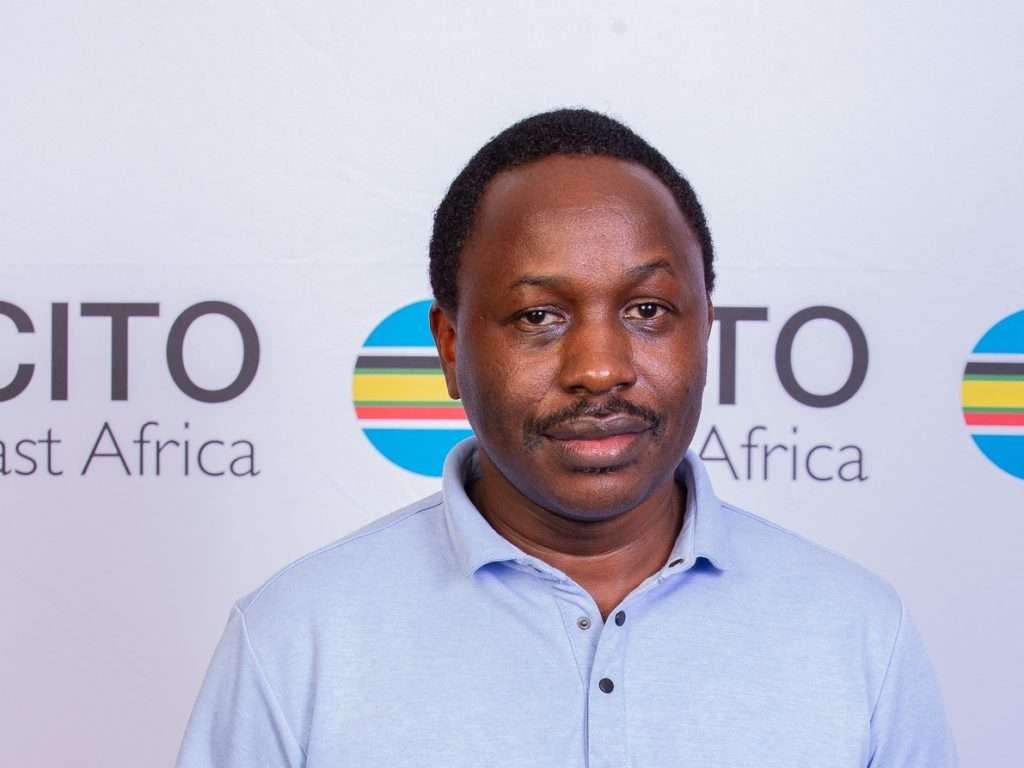
Whenever anyone says they work in IT, society pictures the archetype of a male always clad in a black hoodie. This stereotypical representation of IT professionals, especially in films, also portrays them as introverted nerds. However, this portrayal is far from the truth and Henry Abea is proof of that.
Henry Abea is the ICT manager at Mwalimu National Sacco. Being in leadership, his work is mainly giving strategic direction and ensuring that his team is helping drive the objectives of the organisation forward.
“One of my first duties when I came in was segregation since you can’t have everyone doing everything. Now we have people in networks, in security, in databases and then we have system admins or support specialists,” he explains.
Unlike the stereotypical IT professional, Henry is a jovial fellow with a knack for storytelling.
Henry traces his journey back to the days after his secondary school. He had just received his final examination results and was hoping to join University to study law. Back in those days, there wasn’t much to do and young people would keep themselves busy by studying what were called computer packages which entailed the basics of computer operations. He was also vigorously applying to get into law school on the side. His efforts paid off and he got accepted into a school. Unfortunately, that was as far as his luck went.
“The program I found was too expensive and my parents could not afford it. Instead, they asked me to look for something more affordable,” he narrates.
With his dream to become a lawyer having come to an unceremonious end, Henry sought advice from his dad’s former workmate and settled on IT.
A rocky entry to IT
While graduation for other people meant joining the workforce and having a financial breakthrough, for Henry, it signalled the start of a rather unpleasant tiresome journey of looking for employment. Like most young people his age, Henry moved to Nairobi hoping to find something. His first job was as an attendant at a pool table in Kibera that was owned by his friend’s uncle. While working there, he kept applying for other jobs and was successful finding one, or so he thought. He left the pool table for his new work place but became concerned when two weeks into the new role, he had not received an offer letter. His quest to get one also proved futile and he opted to leave the place barely a month after joining.
“Someone told me that I might never actually be employed, that I would work for three to six months during the probation period, and once it ended, they would simply replace me with someone else for the same role,” he recalls.
After quitting, he got a few other jobs but quit because of unfavourable conditions. Despite the setbacks, Henry was resilient enough to keep trying, and after three years he secured an internship at a Sacco.
“When implementation was complete after around six months, I had understood their system. When the management was told that the vendor, including me, was leaving the site, they gave me a job. No interview, no paperwork, I signed that letter,” he says.
Henry’s journey to where he is now has been one of steady growth. When he joined Elimu Sacco after leaving Sotico and later leaving Orthodox Development Sacco as a systems administrator, he joined as an ICT assistant manager. After three years of hard work and dedication he was promoted to ICT Manager in 2014.
He learnt the leadership trade at Elimu Sacco for 9 years and later moved to Kimisitu Sacco where he delivered a digital transformation agenda. Three years into it and he shifted gears to Mwalimu National DT Sacco which is the biggest Sacco in Kenya and Africa and 7th in the world, where he is leading tech evangelism and service delivery through technology.
The highs and lows
Looking back at his career, two moments stand out. One was that he got his first job seemingly out of nowhere.
“I was not even looking for a job. I just wanted to join the company for growth and learning,” he says.
The second highlight of his career was the day he went for his interview at Kimisitu. He had a board retreat with his then employer Elimu Sacco and he had to send a regret email that Friday morning since the interview time was coinciding with his presentation to the board. Kimisitu was gracious enough and offered to do the interview online later that day. His interview went exceptionally well and by the following Monday, he was given his offer letter after.
Even though Henry has had many successes to celebrate, he has also had some low moments. For instance, early in his career he had gotten a job at a rather small sacco. At the time, the cooperative was trying to introduce a FOSA section and needed to have a system ready for that. Henry realised that the servers the sacco had ordered before joining were of very high specifications and hence expensive compared to its operations. He then advised for lower specifications and cost-effective ones.
“The then Sacco chair asked me whether I was sure that if we reduced the costs, everything would still work. I told him yes. Looking me in the eye, he said that if it didn’t work he would sack me. This was just three days into the job,” Henry recalls.
While Henry was sure that the infrastructure would work, he felt that the threat was not necessary and was unwarranted.
“That was a low moment for me. We hadn't even known each other because it was the third day. To add pain to injury, the entire time those guys were not paying our salaries in full or on time. We were being paid almost a quarter because there's no money coming in. I guess this was the hardest part in my career. I was just lucky that I had some savings that I was surviving on after moving to Nairobi,” he recounts.
Outside the office
Henry’s world outside of his career revolves around sports both as a player and as a fan.
“I'm a member of two football clubs. I play football every Saturday 7am to 9am for one team and 9 am to 11 am for the other team. When I have enough energy, I can play for the two teams on the same day,” he reveals.
His days as a pool attendant have also come in handy as he plays pool in his free time. In the evenings he turns from player to fan as he cheers on Arsenal, of which he is an ardent fan. He also enjoys playing scrabble and table tennis once in a while.
Like every other professional in his field, Henry recognises the power of constant self-development and improvement. For instance, he is currently pursuing a certification in CISA. He is also an avid reader with an affinity for management books. Since he runs a busy schedule, Henry has dedicated an hour every day between 7.00 and 8.00 am before starting his day. He is currently reading the Humanised Leader by Doctor Martin Oduor Otieno in a bid to become a better leader in his role at Mwalimu National Sacco. Henry is also forward looking and strives to stay abreast with current technology.
“It is an AI era, and we are elated by our recent launch of an AI-enabled contact centre solution with agents and our bot already deployed to enhance service delivery,” he shares. “At Mwalimu National, we continue to learn, grow and stay ahead of the pack in technology utilization for financial inclusion.”