
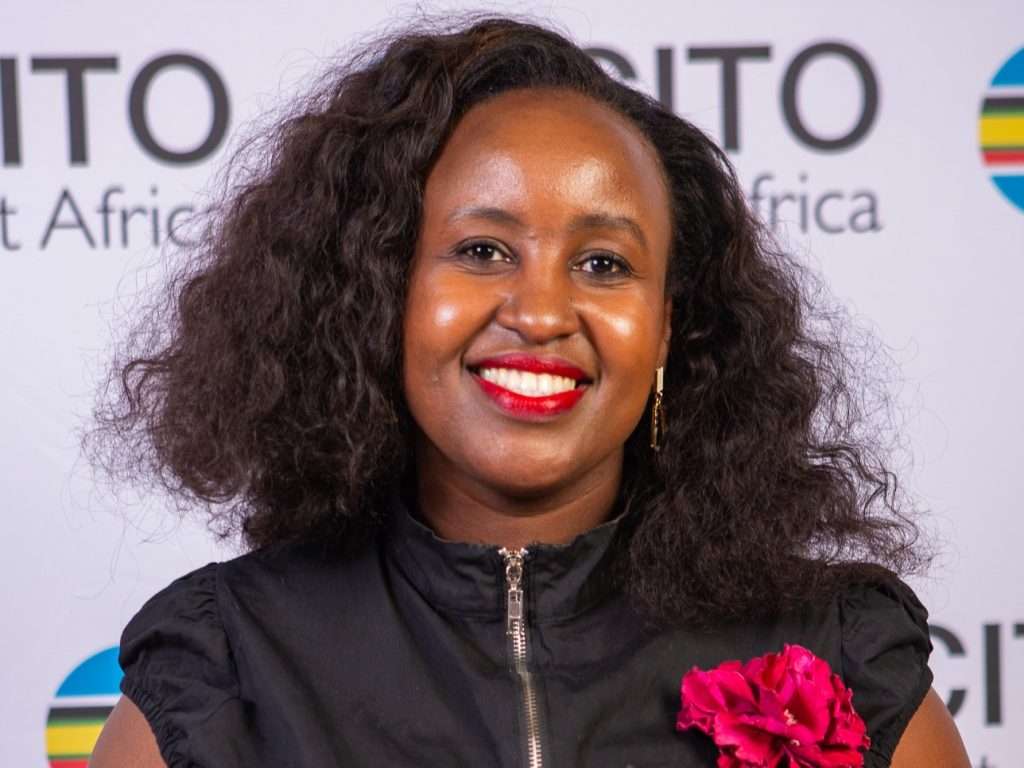
Faith Nkatha’s career spans some of the region’s top leadership roles in tech and strategy; but it’s her unwavering faith and sense of purpose that define her journey. Whether in the boardroom or the pulpit, she leads with heart, believing that every assignment is divine and every role is a chance to change lives.
Faith Nkatha Gitonga’s CV reads like a highlight reel: director of strategy and transformation in banking, tech leader at Oracle, country manager at Cellulant Kenya, and now interim country director and head of technology & digital transformation at the Tony Blair Institute.
But if you ask Faith what she’s most proud of, she won’t start with her titles; she’ll start with her purpose.
“My work is so much more than what’s on my job description,” she says. “I believe I am placed in different organisations for a bigger purpose.”
From early in her career, Faith has always believed that she’s not just about business outcomes but about building people too.
“Everywhere I’ve worked, I’ve proven it. I’m sent there for somebody or for people. And it’s interesting that most times there’ll be projects that will get done, but I can always trace a person, or a few people, whose lives were the real assignment,” she says.
At the Tony Blair Institute, where she leads both the tech strategy and overall country operations in Kenya, she talks about the work in an almost pastoral tone. It’s not just digital transformation; it’s also about impact and legacy. The Tony Blair Institute for Global Change (TBI) works with political leaders around the world to drive change. It is a not-for-profit organisation that provides expert advice on strategy, policy and delivery, unlocking the power of technology across all three.
“It is work that I know our children will talk about one day. At Cellulant, I had a seat at the table on financial innovation. Here, I get to think about things like strategy, policy, delivery, government priorities like food security and so on. This is how nations change,” Faith says.
The “why”
But it’s not the scale that excites her most. It’s the “why” behind it.
“I genuinely believe I’ve been sent. And when maybe that assignment is done, when I’ve played the role I needed to play in someone’s life, then I move. It’s not just about promotions or new offers. It’s about timing. Purpose,” she reflects.
Faith’s leadership is purpose-driven, but it’s also deeply personal. She’s intentional about showing up for the people behind the work.
“Sometimes, someone on my team comes and says, ‘Faith, I’m going through something in my personal life,’ and I know that’s the moment that matters. It’s not a formal mentorship program. It’s not even structured coaching. But it’s real. And it changes people,” she adds.
Her commitment to walking with people on their journey, whether it’s coaching someone into leadership, understanding a concept at work, teaching someone public speaking, or helping a colleague see their own potential, is part of what makes her a different kind of tech leader.
“We’re human beings, not laptops,” she says. “We don’t just plug in and execute. We carry stories, dreams and pain, and as leaders, we have to see that.”
The start of a tech career
Faith’s journey into tech wasn’t scripted. It started with dreams of medicine, a brief romance with radio and TV in her university years, and a vow to never work in a bank – a vow she laughingly broke when she joined Chase Bank and fell in love with the world of finance and digital transformation.
“I told myself I’d never work in a bank. Then I joined one and had the time of my life. Chase Bank was like a leadership school. And when tech started creeping into strategy, I knew I couldn’t reach C-suite without understanding it,” she says.
So, she pivoted. She joined Oracle, dove deep into learning, and didn’t just skim the surface. She blocked out Fridays for intensive training, studying cloud, digital transformation frameworks, and how to explain them in plain English.
“I told myself if I’m going to lead in tech, I need to know what I’m talking about. Not just buzzwords, but real solutions,” she explains.
Eventually, Cellulant came calling, and Faith stepped in as country manager for Kenya. This was in the middle of Covid-19.
Hard decisions
“It was wild. I didn’t meet most of my team in person until months in. I kept telling people, ‘Put your camera on!’ because I needed to build connections, even if virtually,” Faith reveals.
At Cellulant, she helped the company finally secure a payment service provider licence.
“That licence, it was a battle. But we got it. And I learnt that resilience, especially the kind you build in banking, pays off in fintech,” she notes.
But then came one of her hardest leadership decisions yet: turning down a public sector C-level appointment.
“I had just had my fourth baby. Two weeks into maternity leave, they sent me the appointment letter. And I looked at my newborn, then the letter, and thought: I could wear a suit that doesn’t fit yet and pretend I’m fine. Or I could say no, for a bigger yes later when the time and season was right,” she says.
She chose ‘no’.
“It was so hard. But you know what? We teach women to say yes. We don’t teach them when and how to say no,” she says.
Her clarity came not just from instinct, but from her support system, what she affectionately calls her ‘personal board of directors’. Her husband, her family and close friends all weighed in, not as colleagues, but as people who know her life, not just her on LinkedIn.
“You need a support system that knows your real world. Not just your resume. My dad told me, ‘You’re still young. This job will come again. But you’ll never have another maternity leave with this baby.’ That’s what grounded me,” Faith explains.
She adds with a smile, “And let’s be honest, my husband’s been a rock. Four boys and one powerhouse woman? It’s teamwork!”
Faith is quick to point out that career success is never just about hustle, it’s about wisdom, timing, and choosing what matters in each season. Right now, for her, that’s balancing her leadership role with raising her sons and making time for her marriage and church community.
When her father passed away, and she was writing his eulogy, she was again given the opportunity to consider what’s most important in life. “I didn’t list his accomplishments. I talked about how he was a present dad, helped us with homework and more. How he took us on road trips. That’s what people remember. Not the job titles,” she says.
And this is why she feels so invigorated by her current role. “At TBI, I feel like I’m part of something generational. This is legacy work. Government transformation, tech for food security, digital public infrastructure; it’s not just another project. It’s something our children will talk about,” she says.
“Everywhere I go, I believe I’ve been assigned. My work is always more than the job description. I mentor, I preach, I speak, I listen. I achieve results. If someone says, ‘Faith, help me understand tech,’ or ‘Teach me to lead,’ that’s a highlight. That’s why I show up,” she explains.
Beyond the office
Faith’s purpose doesn’t end at the office door. She preaches and mentors women and young people. She speaks in churches, conferences, tech events and other professional forums, answering invitations to talk about digital transformation, women in tech and courage as a corporate woman.
“If you don’t find me with my family or at work, you’ll probably find me speaking somewhere – to women, to young leaders. Or I am preaching. God is core in my life. I credit Him for where I’ve been, and where I’ve gotten to,” Faith says.
Faith leads with purpose, listens with heart, and lives like every assignment is sacred. “God sends us. We fulfill the purpose. Then He moves us. That’s the rhythm I try to follow,” she concludes.