
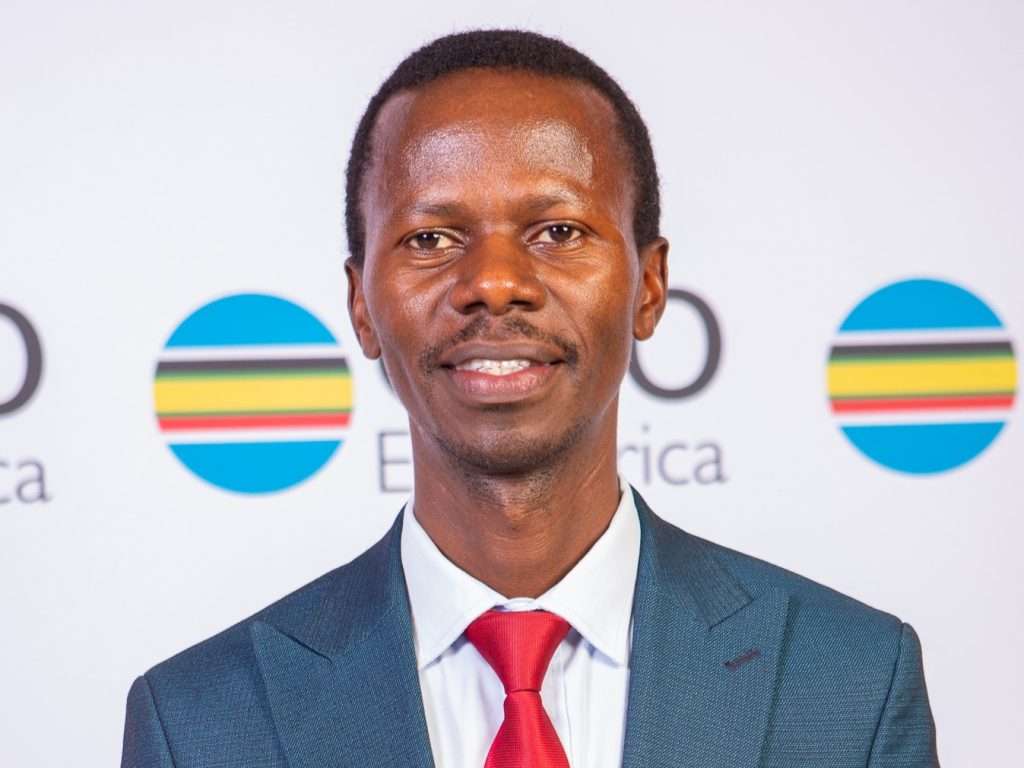
Dr Mwirigi Kiula’s life has been marked by hardship, resilience, and faith. Growing up, he struggled to stay in school due to financial constraints. Today, he serves as the deputy vice chancellor of finance and administration at St Paul’s University, leading with the conviction that every challenge is part of God’s greater plan.
Dr Mwirigi Kiula looks resplendent in his spacious office, the door proudly bearing his new title: Deputy Vice Chancellor, Finance and Administration, St Paul’s University. But even with the weight of leadership on his shoulders, he has not forgotten where he came from. He reflects on his tough childhood that tested him in every way, while remaining grateful for all his experiences and the training thereof. “It has been a tough journey but for the grace of God,” he says.
He recalls a night of being chased out of a relative’s home with his younger sister, long days of carrying farm produce for dozens of kilometres, and evenings of doing homework on his mother’s back in a crowded one-room shelter with only a tin lamp as the source of light. “I did not have textbooks or even a proper uniform, but I found ways to study. Sometimes I traversed the village late at night to borrow books and complete homework. I just knew I had to keep going,” he says.
At just 14, he built a structure for his mother so he and his five siblings could finally have a shelter.
“I looked at my mum that Saturday afternoon, with my little siblings lying under a tree, no shelter of our own, tears rolled down my cheeks, and I made a determination to build a shelter,” he reflects. “It must have been a three by two square metre, but it became our home for the next several years.”
By age 15 he had already learnt to take care, singlehandedly, of the five siblings. The struggles, he explains, gave him a sense of resilience and resourcefulness that continues to shape his leadership today.
Mounting challenges
Yet one of his toughest challenges came after he sat for his Class 8 exams at Muciimukuru Primary School. Despite his determination, he was unable to raise the fees to join secondary school. After struggling to raise school fees, Julius Kiula, Mwirigi’s father, still held onto hope against all odds. He convinced the young boy to repeat Class 8 at Mutionjuri Primary School. “Go back to school, as we sort your fees,” Mwirigi recalls his father saying.
The hardships were not only economic but sometimes life-threatening. As a boy, Mwirigi nearly drowned while helping others cross a flooded river, only to be pulled out and immediately face the terror of a python encounter on the riverbank. It was two weeks before the KCPE exams in 1994 in which he was a repeat candidate. “I believe surviving that moment was God’s way of telling me that my life had a purpose,” he reflects. “It gave me the courage to face bigger challenges.”
He was determined to make the most of his second chance even though he had to balance between odd jobs in the village and keeping the education dream alive. In the second attempt he excelled in his KCPE exams, scoring high enough to be admitted to the prestigious Alliance High School.
It was not yet over. Having passed the second round of KCPE with exceptional results, the family financial situation was worse than ever before. His turning point came unexpectedly when church elders followed up on this little boy with such unprecedented Class 8 exam results who was chosen to join a national school. The chairman of the school visited the family to confirm the identity of the young boy and how he would enrol into high school. This new feat jolted the community into action. “We can’t convince other children to take schooling seriously if we don't get this boy to join this prestigious school,” Mwirigi recalls the determination of the Mutionjuri community.
Fast forward, the elders quickly marshalled support of the church and the village. There were cash, grain and livestock donations to raise the Ksh13,920 in school fees for the first term at the Alliance High School. “That was the moment everything shifted for me,” he says. “I went from almost giving up to joining one of the top schools in Kenya. It showed me that with determination and a bit of help at the right time, the future could completely change.”
Finding his feet
At Alliance, the adjustment was not easy. Coming from a rural background, Mwirigi struggled at first to fit in. “I spent the first two weeks on punishment because my peers could not even understand my English,” he remembers with a smile. “I was like a dent in the matrix of national school by a village boy,” he observes.
But slowly, he found his footing. Surrounded by some of the brightest boys in the country, he pushed himself harder, determined not to waste the chance he had been given. “I meticulously read books and gave speeches to bushes at the barn to improve my spoken English and my confidence,” he says.
At Alliance, he swept a teacher’s compound and prepared cattle feed for another to raise bus fare for taking him back home at the end of the term or get some pocket money for use during the term.
“I am forever grateful to Mrs Marete and Mrs Kihwaga. These two teachers gave me a chance to do a form of work-study in the staff houses, earn and fill the financial voids. My parents did not set foot into the school during my four years,” he recalls, then adds: “Would they use their little money on bus fare or give it to me as pocket money?”
By the time he sat for his Form 4 exams, his persistence paid off. He performed well enough to secure a place at university; a milestone he once thought impossible. For a boy who had nearly dropped out after Class 8, the chance to step into higher education was nothing short of transformative. “University was proof that my struggles had not been in vain,” he says. “It showed me that hardship is not the end, it can be the beginning of something greater.”
University, however, came with its own battles. While admission was a dream fulfilled, paying fees was another story altogether. “My family could not support me financially, so I had to find my own way through,” Mwirigi recalls. To survive, he relied on the kindness of well-wishers, countless side hustles and the stipends as a student leader at the JKUAT Students Organisation (JKUSO).
A remarkable journey
After completing his studies, Mwirigi began his professional journey in 2004 with community mobilisation and ICT capacity-building initiatives. I had the special privilege of obtaining an internship at the Kenya Education Network just a week after the final exams to build the first Kiswahili website before joining Octagon Data Systems as a systems analyst and later Jomo Kenyatta University of Agriculture and Technology (JKUAT) as a systems administrator. There he rose through ICT leadership roles, including head of research, consultancy and training, and later ICT director. In 2013, he championed the rollout of the Taifa brand of locally assembled laptops, reinforcing Kenya’s “buy Kenya, build Kenya” agenda.
Between 2020 and 2025, he served at Kenyatta University Teaching, Referral and Research Hospital (KUTRRH), where he spearheaded digital transformation, established the medical innovation and accelerator hub, rolled out an end-to-end hospital-wide management information system, and won recognition including Chief Technology Officer of the Year 2025 from Kenya’s Ministry of ICT and the Digital Economy. KUTRRH was a remarkable journey, fast-paced, adrenaline-tinged, sailing with a sense of urgency. “What else did you expect under the leadership of the legendary Prof Olive Mugenda?” he quips.
In June 2025, he was appointed as the deputy vice chancellor of finance and administration at St Paul’s University, where he now leads finance, administration, ICT, HR, and strategy implementation. “For me, ICT has never been just about systems,” he says. “It is about opening doors, empowering people, making an impact and creating opportunities for those who might otherwise have been left out.”
Looking back, Mwirigi believes that none of his struggles were in vain. For him, every obstacle and turning point fits into a bigger plan. “I have no doubt that my life is a testimony of God’s grace,” he says. “From being chased out of homes, to nearly drowning in a river, to almost dropping out of school, I know God preserved me for a reason.”
That conviction continues to guide his leadership and outlook. “I believe God placed me where I am today, not just to work with technology or administration, but to touch lives,” he reflects. “Every responsibility I have is part of His plan, and my role is to serve faithfully.”
For Mwirigi, the lesson is simple yet profound: “Faith is what carried me when I had nothing else. It is faith that keeps me going. Whatever I have achieved, it is because God had a purpose for my life.”