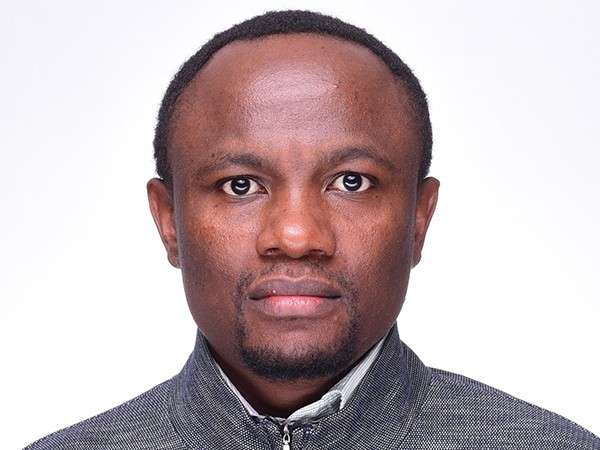
In another life, where computers never came to Kenya and cyber cafes were non-existent, Nicholas Musau would have been a nurse running long shifts, doing rounds in hospital wards and taking care of patients. However, in this life, Nicholas is the IT Manager at Basi-Go, an e-mobility company that aims to revolutionise public transport by introducing electric public transport vehicles.
Nicholas Musau’s career trajectory to becoming a medic was hijacked by an unprecedented turn of events over two decades ago. He had just completed his secondary school examinations but did not attain the required marks to join medical school. His father was determined to do everything in his power to instead ensure that his son joined the Kenya Medical Training College (KMTC) as a path to achieving his dreams. Nicholas, on the other hand, found himself frequenting the newly opened and mushrooming cyber cafes. During this time, a seed was planted in him that kept growing with every visit unbeknownst to him.
“What drove me to IT was curiosity. This was the time when people were beginning to get email addresses, cyber cafes were the in thing in Nairobi. People did not have laptops in their homes. We would go to get our projects done in cyber cafes and I started wanting to know how the internet works and how automation works,” he recalls.
His quest for answers soon morphed into a firm resolve to pursue IT as a career, a move that saw him achieve pursuing both a Bachelor’s and a Master’s degree as well as several diplomas in IT. Nicholas entry was teaching in IT rather than working directly with computers. With time, however, he secured a role at Geomaps Africa Rwanda and thus began his long, illustrious career in IT.
Having worked in the same field for over 20 years, Nicholas looks back at his career both with gratitude for and pride in some of his achievements. At the top of his mind is the roll out of Nestle’s ISO certification, a project that put his influencing and leadership skills to the test.
“It involved working with different teams across different cultures, and people that did not report to me so it was a lot of using my influence as a junior person to convince the management and the teams that we had to follow a certain path to get certification,” he says.
After being with Nestle for close to a decade, Andela came calling and Nicholas answered. This time, he held the position of global director of IT. While this in itself is a cause for celebration, Nicholas instead chooses to focus on the ICT strategy he helped launch in Andela and the fact that he built it from scratch. The strategy he developed saw users increase from 400 when he joined to about 1500 in 2020 when he left.
“Building the strategy involved a lot from automation, to IT security, to compliance and yet I came up with the system by myself without any predesigned processes in the organisation that would otherwise have been pre-defined in bigger organisations.”
While Nicholas is proud of his achievements, he does not shy away from his failures over the period of his career. A case in point is when he failed to meet a workplace group audit while working at Nestle after failing to comply with certain internal processes. While he does not go into the details of how or why he failed to comply with the said processes, he reflects on the impact the results of the audit had on him.
“I did not really fail but my performance was below satisfactory. I felt like that was a huge failure on my end.”
Fortunately for him, the audit was before the ISO certification rolled out and he got a chance to redeem himself. His vast experience leading in the implementation of infrastructure projects across Africa in previous years was helpful to ensure that most of these audit findings were closed hence clearing the path for compliance, which was also a key pillar for a continuous improvement that the company was pursuing at the time.
Safety in the world of AI
Looking back at his career, Nicholas notes that the IT landscape is different from what it was years ago and what worked then might not work now. For example, in the modern world, thanks to AI, one can write code without having to learn programming languages. While AI is a sore spot for some people, Nicholas feels that it cannot be ignored and is in fact, a welcome innovation but only if adopted with caution.
“Everything that’s coming now has an AI factor. One of the challenges we must be concerned about is data protection and data privacy. There needs to be guidelines and policies that regulate AI adoption and use.”
Nicholas is especially worried by the fact that Kenya does not have a specialised AI framework even though currently being regulated through the data protection act 2019, the proposed National AI framework aims to bridge this gap.
“People upload a lot of information, some of which may be sensitive especially when doing data analysis. This is a major problem since they do not know how AI dumps that data.”
Therefore, Nicholas advises companies to ensure that data is used correctly adding that over exposure may have grave consequences in the future. Even then, he celebrates the fact that there are more Africans creating technological solutions for Africans.
“It’s good we are starting to see some innovation coming from Africa. We are seeing people who have the local context coming up with solutions that suit us as Africans and that means we have more control. We are also seeing more localisation of resources. For example, Kenya now has around 19 data centres. It might be insignificant compared to the USA’s which has over 4,000 but we are starting from somewhere ,” Nicholas says.
Nevertheless, he insists that the future will need more creativity as opposed to theory especially, in IT related fields.
Even after the many years Nicholas has spent in IT, he has not once entertained the idea of pivoting to another career field. The fact that IT keeps evolving is enough allure to keep him glued to this field especially because he loves learning. In fact, by his own admission, Nicholas hates repetitive tasks and is always looking for the new.
“If a task becomes repetitive even in the office, I am happy to delegate where possible,” he confesses.
Yet for a man who harbours a silent disdain for repetition and monotony, his inner world is anchored in nostalgia, a striking irony to his neophiliac approach to his career. His musical taste is still heavily influenced by mid-nineties hip-hop. He is especially drawn to artists whose lyricism remains difficult to replicate and continues to shape younger generations.
Nicholas’s tendency to look back to what was extended even to his career. In a world where everything is uploaded to the cloud, Nicholas misses the era of physical server rooms.
"I miss having the local infrastructure. I felt a lot of control knowing that I almost had end to end control of all my servers and data in the office,” he recalls.
Beneath this wave of nostalgia lies a small hint of sadness at the fact that data is moved elsewhere for other people to control the platform.
“Cloud is just moving the same infrastructure to sit in someone's compound. Basically, we just transfer those jobs and expertise elsewhere and we become end users. A bulk of the younger IT professionals might never get the chance to design server rooms or do physical servers otherwise most of the smaller organisations have mainly adopted cloud first policy” he says.
A philosophy of balance and planning
Beyond the daily hum of computers, the strings of code and the mountains of paperwork that characterize his role at BasiGo, Nicholas is a father and a hobby golfer, facts that he reveals early on, evidence that his world does not solely revolve around his career. Both parenting and golfing have been classes where he has learnt a great deal of patience and coordination. He also appreciates the fact that golf has allowed him to network with people from different professions and generations and to develop grit.
“Sometimes you play so badly but by the time you get to your eighteenth hole you want to come back the following day because you are optimistic of a win. It’s also a good game for introverted people because you have a whole round of 18 holes to talk with people, there is no way you won’t socialize,” he says.
Nicholas believes in planning not just as a workplace philosophy but as a fundamental outlook towards life.
“You must set goals at the end of the day. Sometimes you might miss those targets but if you remain focused you will still do it one way or the other. The issue is not having goals at all,” he notes.