
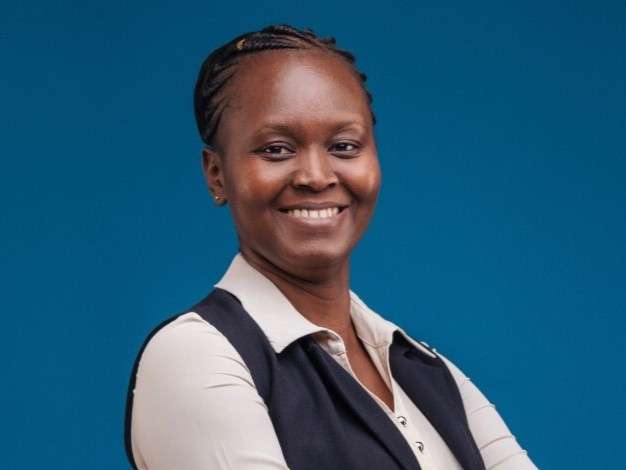
Faith Muricho, operations manager at AWS Kenya, credits her growth in tech to mentors who believed in her before she believed in herself. From leading Absa’s tech rebrand to helping launch AWS in Kenya, she has built a career rooted in problem-solving, resilience and leadership. She is passionate about mentoring young professionals and making technology and AI more accessible.
Faith Muricho believes in the quiet power of people who cheer you on when you don’t see your own potential. Throughout her journey in technology, she has learned that growth is about the courage to keep showing up, the humility to be mentored and the joy of lifting others along the way.
Learning to see herself through others
“I go back and ask the people who held my hand then, what was it you saw in me, because I didn’t see it until much later?” she says with a laugh.
Her story is told with the easy laughter of someone who remembers where she started and is determined to make the journey easier for those who come after her.
Faith often describes herself as “just a village girl who stumbled into tech out of curiosity.” Growing up, computers were a mystery, something she only heard about in passing.
“I grew up in the village and those days computers were such a rare occurrence," she recalls.
When it came time to choose a course, she simply asked herself what was new in the market and decided to try computer science.
“Everyone wanted to be a doctor, a lawyer, or an engineer. I just thought, why not try something different?” she says.
That curiosity set her on a path she never imagined, one that would lead her from classroom labs to leading complex technology operations years later.
Starting out was anything but easy. Faith’s first encounters with computers came through community projects in Nairobi’s informal settlements, where she trained young people in basic IT skills.
Technology as a tool for empowerment
“That was my first real exposure to Nairobi,” she says. “We would go into places like Huruma and Jericho, setting up computers and teaching people how to use them.” It was hands-on, unpredictable work that taught her to adapt quickly and find solutions on the go.
Beyond the technical side, it showed her that technology is a powerful empowerment tool; the way a single computer could open up a new world for someone who had never imagined working with one.
“You could see their eyes light up when they typed their name for the first time,” she recalls.
It also planted in her a deep sense of purpose, that technology should never be a privilege for a few, but a bridge for everyone to access opportunity.
That early sense of purpose became the thread running through Faith’s career. As she transitioned from community projects into the corporate world, she carried with her a belief that people, not systems, are the heart of technology.
Along the way, she met mentors who saw in her great potential. “I had leaders who believed in me even when I was doubting everything,” she says. “They would keep telling me, you can do this, just focus and try again.”
Their faith in her gave her the courage to take on roles that stretched her and to view leadership not as authority, but as a form of service.
Leadership forged through change
One of her defining moments came when she was part of the team leading the transformation of Barclays into Absa. It was a high-stakes project that tested her resolve and demanded long hours of coordination and problem-solving.
“I was so invested in that project; it felt very personal to me,” she recalls.
Seeing the new brand come to life and the systems run smoothly gave her an immense sense of pride and confirmed that leadership, at its best, is about guiding people through change with steadiness and care.
“Every time I see the Absa logo, I still feel a sense of pride,” she adds.
Faith’s experience at Absa strengthened her belief that leadership is built in moments of trust and uncertainty. So, when she later applied for what she thought was a manager role in a startup, she carried that same sense of responsibility and calm. Only after receiving the offer letter did she realise the position was at director level.
“I honestly thought they had sent me the wrong letter,” she says with a laugh.
For a moment, she doubted whether she could fit in those shoes. But a mentor’s advice helped her reframe her thinking. “He told me, read the job description without looking at the title. Can you do the work? And I realised I could.” It was another reminder that growth often comes disguised as discomfort and that courage sometimes begins with simply saying yes.
Today, Faith draws from those lessons every time she mentors a young professional who doubts their readiness. She reminds them that confidence often follows action, not the other way around.
“I tell them, you do not have to feel ready to start. You grow into it,” she says. Her approach to mentorship is personal and practical, rooted in empathy. She shares her own stories of hesitation and growth to show that even the most seasoned leaders once questioned themselves. Helping others step into their potential is her way of honouring the mentors who once believed in her.
Keeping the circle of mentorship alive
That same belief in lifting others shapes how Faith sees the future of technology. She is passionate about making tech a space where everyone belongs, not just those with the right background or access.
“Tech should never feel like a closed club,” she says. “Everyone should have a chance to understand it and to be part of it.”
For her, inclusion is not a trend but a necessity, especially as artificial intelligence becomes part of everyday life. She often shares free learning resources, encourages young people to explore coding and digital skills, and pushes for open conversations about the ethics of technology. In her view, true progress means creating a world where innovation opens rather than closes doors.
According to Faith, success is about growth and impact. She finds fulfilment in seeing people she has mentored step into their own confident spaces and in knowing that her work, whether in tech, leadership or community, creates ripple effects that outlast her role.
“I have learned that purpose is not one big thing you find; it is in the small ways you show up every day,” she says.
As she reflects on her journey, Faith concludes by saying, “If someone believed in me when I could not see my own potential, then I have a responsibility to believe in others too. That is how we keep the circle of mentorship alive.”